
I wrote “five times heavier” in the margin of my first notes on americium power. Then I crossed it out. The fuel, under a particular set of assumptions, yes. The whole generator, no. Quite a lot of this story lives in that distinction.
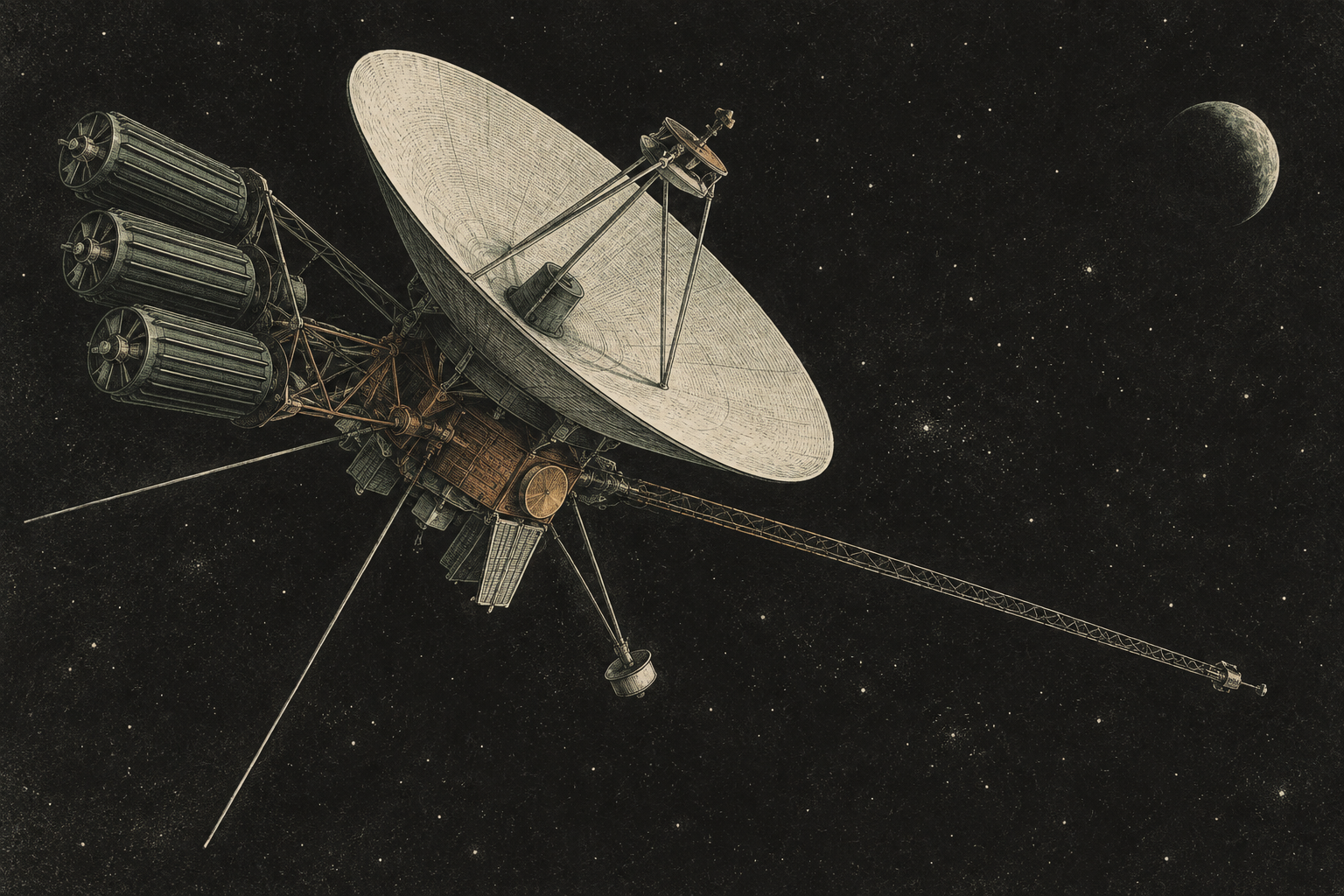
Voyager makes a good place to begin. A spacecraft can keep its plutonium and still lose electrical power: the isotope decays, the temperature difference across the converter changes, and the converter itself ages. A fresh supply of fuel on Earth cannot help the machines already out there. For the next spacecraft, though, the supply chain matters almost as much as the isotope.
It cannot be switched off. It cannot be switched on. That is useful on a cold spacecraft. It is also an obligation to deal with the heat during assembly, transport, launch and every operating mode thereafter.
Start with heat, not electricity
A radioisotope thermoelectric generator, or RTG, uses decay heat to maintain a temperature difference across thermoelectric elements. These are engineered semiconductor couples, not merely a pair of ordinary wires. The Seebeck effect produces a voltage; a connected load draws current. There is no sustained fission chain reaction and no mechanical engine in a conventional RTG. A radioisotope heater unit, or RHU, simply supplies heat. It has no electrical conversion stage. [1]
For a pure isotope, the starting estimate for thermal power per unit mass is:
Here T½ is the half-life in seconds, M is molar mass in grams per mole, and Eheat is the energy deposited locally per decay in joules. With those units, p comes out in watts per gram. The rate of decay is doing most of the work in this comparison.
| Property | Plutonium-238 | Americium-241 |
|---|---|---|
| Half-life | 87.7 years | about 432 years |
| Specific thermal power | ≈ 0.57 W/g | ≈ 0.114 W/g |
| Heat retained after 30 years | 79% | 95% |
| Main decay mode | Alpha | Alpha, with photon emissions |
The specific powers are approximate pure-isotope values, not a specification for a finished fuel pellet. NASA’s educational material uses about 0.57 W/g for Pu-238; americium research reports 0.114 W/g for Am-241. Published evaluations differ slightly in the quoted americium half-life. That difference is immaterial at the precision used here. The retention percentages are my calculation. [2] [3] [4]
Americium is not a weaker fuel in any absolute sense. It is a slower one. Similar energy is released per decay; fewer decays occur each second per gram.
What 50 electrical watts actually asks for
Assume a 6% heat-to-electricity efficiency. This is an illustrative common efficiency, not a prediction that two real generator designs will perform identically. To obtain 50 W of electricity, the converter needs about 833 W of heat.
mPu-238 ≈ 833 / 0.57 = 1.46 kg
mAm-241 ≈ 833 / 0.114 = 7.31 kg
These are masses of the active isotopes. Add oxygen, any other isotopes or stabilising constituents, containment, insulation, thermoelectrics, fins, mounting hardware and shielding before you have a generator. As a reality check, NASA quotes roughly 4.8 kg of plutonium oxide and 110 W of initial electrical output for an MMRTG. Dividing electrical watts by pure-isotope watts per gram would not reproduce that hardware inventory. [1]
There is a second correction to my margin note. At equal electrical output and equal efficiency, both hypothetical units reject about 783 W of heat. Five times as much isotope does not mean five times the rejected heat. Radiator area depends on temperature, emissivity, geometry and surroundings; a lower operating temperature can demand more area for the same heat load. You need the thermal design before you can price that penalty.
Nor is poor efficiency something engineers can cheerfully ignore. Raising efficiency from 6% to 12%, with everything else held constant, halves the required decay heat and active fuel mass. There will be other trades. But scarce fuel is a very good reason to care about conversion.
An inventory is not a finished heat source
The supply argument begins with a different plutonium isotope: Pu-241. It beta-decays to Am-241 with a half-life of about 14.3 years. Americium therefore accumulates in stored reactor-derived plutonium. That is a different process from producing Pu-238 deliberately for spacecraft. [5]
Even the phrase “accumulates” has a qualification. The daughter isotope is also decaying. For an initially americium-free quantity of Pu-241, the two-member decay-chain solution is:
× (e−λAm t − e−λPu t), λ = ln 2 / T½
After 30 years, about 75% of that initial Pu-241 atom population is present as Am-241, using the rounded half-lives above. That is emphatically not 75% of the entire plutonium stockpile. Its starting isotopic composition and storage history determine how much americium is there. Any americium already present contributes its own decaying term.
Britain’s stored material provides a feedstock. Recovering it, qualifying a ceramic, sealing a source, demonstrating containment and establishing repeatable manufacture remain industrial work. The Leicester and National Nuclear Laboratory team demonstrated electricity from recovered americium in 2019. The spontaneous nuclear transformation is free of an electricity bill; the flight article is not. [6]
Pu-238 production is also real, rather than something the United States has abandoned. Oak Ridge reported a 550 g shipment in 2023 and then described a target of 1.5 kg annually by 2026. A dated shipment and a production target are different kinds of evidence. I would not turn either into an assertion that the target has now been met. [7]
The photons need their own budget
Am-241’s useful alpha decay comes with a photon field. Its familiar 59.5 keV gamma line occurs in roughly 36% of decays. That calls for a dose and shielding assessment for people and nearby equipment; it is not adequately described by saying alpha particles stop in paper. [5]
Pu-238 sources are not literally radiation-free outside their alpha emission either. Spontaneous fission, reactions involving alpha particles, and impurities can contribute neutrons and photons. Source composition and placement matter. A boom can change exposure at an instrument, but also adds structural and thermal complications. [8]
I would resist attaching a universal shielding mass to either fuel. The permitted dose, source geometry, self-absorption, nearby instruments and mission duration all belong in that calculation. “A sheet of paper” is an explanation of alpha range, not a spacecraft radiation assessment.
A long half-life is only one lifetime
The simple decay law is Q(t) = Q(0) × 2−t/T½. Actual electrical output is closer to P(t) = η(t) × Q(t), with converter efficiency and thermal conditions changing over time. The graphic below deliberately isolates the isotope term.
Calculated from 87.7- and 432.2-year half-lives. Decay only; equal initial heat means different fuel masses.
After 300 years, the americium retains about 62% of its initial heat and the plutonium about 9%. That sounds like an easy victory until you remember the different starting powers per gram. For equal initial isotope masses, these rounded numbers put the thermal-power crossover around 255 years. Before that, the plutonium still supplies more heat per gram of starting fuel.
For equal initial heat output, americium needs more starting mass but declines more slowly. Neither comparison promises a working spacecraft after three centuries. Thermoelectric joints, insulation, electronics and the communications system do not acquire a 432-year service life because the fuel has one. I like the idea of a centuries-long lunar instrument. I would like to see its component ageing programme even more.
Where the hardware stands
There is more to report than a laboratory bulb. In April 2026, Leicester announced an americium-fuelled, full-scale RHU core. A separate announcement described vibration and thermal-vacuum tests of a representative structural thermal model. Those are specific milestones. They are not a report of an americium generator operating on another world. [9] [10]
Leicester describes the heater design as planned for Rosalind Franklin. A heater can support a solar-powered rover without replacing its solar arrays. The distinction disappears surprisingly often when all these devices are called “nuclear batteries”. [9]
And the alternatives have not frozen in place. ESA reported in June 2026 that a study found a European Pu-238 supply chain technically and economically feasible using existing capabilities, with a roadmap extending to 2039. That is an assessment, not a production line delivering fuel today. It does make “Europe cannot make plutonium” too absolute a description. [11]
Batteries and sunlight are not categorically excluded from surviving the lunar night. The LuSEE-Night team has published a solar-and-battery design with a 7 kWh battery for night-time observations. It is a demanding design problem, not a prohibition in physics. [12]
I would choose the fuel after writing down the required electrical watts, required heat, operating temperatures, duration, allowable mass and procurement route. Americium gives Europe another workable place to start that exercise. That is a substantial achievement without asking it to replace every plutonium generator, or to keep a machine alive forever.
Calculations use the rounded isotope properties stated above. Sources below distinguish measured milestones from plans. Programme status is described as of 4 August 2026.
Sources & further reading
- NASA — Radioisotope Power Systems FAQ ↗
- NASA Space Math — The Cassini Radioisotope Thermoelectric Generators ↗
- Optimization of Uranium-Doped Americium Oxide Synthesis for Space Application (2018) ↗
- NASA — Nuclear Power Assessment Study, section 3.6 ↗
- National Academies — Radioactive Sources: Applications and Alternative Technologies, chapter 2 (2021) ↗
- University of Leicester — Electricity from recovered americium (3 May 2019) ↗
- Oak Ridge National Laboratory — Pu-238 shipment milestone (2023) ↗
- NASA Technical Reports Server — Radiation from plutonium 238 used in space applications (1971) ↗
- University of Leicester — Americium-fuelled RHU core (29 April 2026) ↗
- University of Leicester — RHU qualification testing milestone (29 April 2026) ↗
- ESA — Europe assesses Pu-238 supply chain for deep space (3 June 2026) ↗
- Saliwanchik et al. — LuSEE-Night power requirements and power generation strategy (2024) ↗
Saved on this device.
Comments (0)
No comments yet.
Comments are closed.